
Rapid diagnostics have a scheduling problem that most supply categories do not. Demand is seasonal and sharp, the product is dated, and manufacturing capacity does not flex quickly. That combination punishes late decisions harder than almost any other category in healthcare supply.
The organizations that stay in stock through a surge made their decisions two quarters earlier, when nobody was thinking about testing.
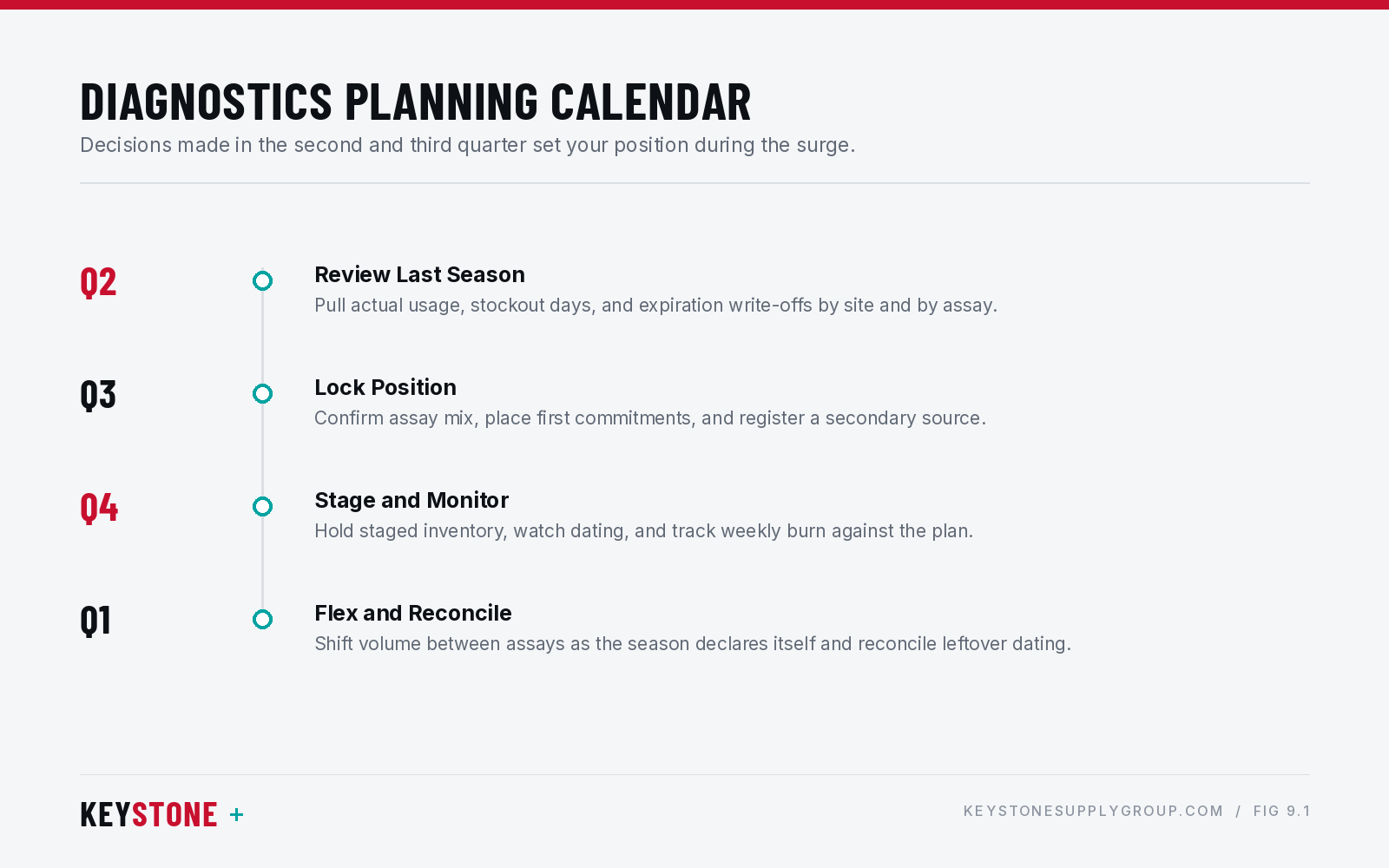
Second quarter: review the last season honestly
Pull the actual numbers rather than the impressions. For each site and each assay:
- Units consumed by month
- Days of stockout, if any, and what was done during them
- Units expired or written off
- Emergency purchases made and what they cost relative to planned pricing
- Which assay formats were actually used versus which were ordered
The two failure modes are opposite and both expensive. Stockouts during a surge send patients and staff scrambling. Expiration write-offs at season end mean capital was spent on product that was thrown away. The goal is a plan that lands between them, and you cannot build that plan without last season's real consumption data.
Third quarter: lock the position
Decide the assay mix. Single analyte versus combination formats, and in what ratio. Combination tests reduce SKU count and simplify workflow. Single analyte tests are often less expensive per test and easier to source. Most organizations end up with both, and deciding the ratio deliberately beats defaulting to whatever is available in November.
Confirm intended use and setting. Point of care, laboratory, or self test formats carry different requirements and different approvals. Confirm that what you are buying matches where it will be used and who will be running it.
Place first commitments. Manufacturers allocate production against committed orders. Position taken in the third quarter is meaningfully cheaper and more certain than position taken in the fourth.
Register a second source. This is the quarter to do the vendor paperwork, not the quarter after the first stockout.
Check dating on everything you commit to. Shelf life determines how much you can responsibly hold. A great price on short dated product is not a great price.
Fourth quarter: stage and monitor
Hold staged inventory in a way that matches how consumption actually flows, keep the fastest moving assay closest to the point of use, and track weekly burn against the plan. Weekly burn is the leading indicator. When it climbs above forecast for two consecutive weeks, act immediately rather than waiting for the monthly review, because that is exactly when the market tightens for everyone else too.
Watch dating during this period as well. Rotating stock across sites is much easier in December than in March.
First quarter: flex and reconcile
Seasons declare themselves. Some years the flu component dominates, some years it does not, and the mix you planned in the third quarter will not perfectly match reality. Shift volume between assays as the picture becomes clear, and reconcile remaining dated inventory before it becomes a write-off.
Then close the loop. The first quarter reconciliation is the input to next year's second quarter review. Organizations that run this loop consistently get better at it every year. Organizations that treat every season as a surprise repeat the same two failures indefinitely.
What to have on file before the surge
- Documented weekly burn rate by site and by assay
- Approved alternate formats with clinical sign off already in place
- A secondary vendor fully approved in your system
- Known dating tolerance and storage capacity per site
- A defined escalation trigger, such as two consecutive weeks above forecast
Set your position early
Keystone sources rapid diagnostics across multiple manufacturers and distribution channels, including combination respiratory formats, and can quote delivered pricing with lot dating stated. We work as an approved secondary vendor so coverage exists before the season peaks rather than after.
Plan your season: Orders@KeystoneSupplyGroup.com | Office (507) 237-6036 | keystonesupplygroup.com