A brand transition looks like a marketing event from the outside. Inside a purchasing department it is an item master problem, and item master problems turn into stockouts.
The 3M health care separation into Solventum touched product identity across widely used lines including patient warming, irrigation and fluid warming, skin and wound care, hand antisepsis, and clinical instruments. Some items simply changed name and packaging. Others changed part numbers. Some were rationalized out of the portfolio entirely. Lead times on a portion of the catalog have run out months.
The organizations that handled this well did one thing: they classified every affected item before they needed it, instead of discovering the status of each SKU one failed purchase order at a time.
Classify first, source second
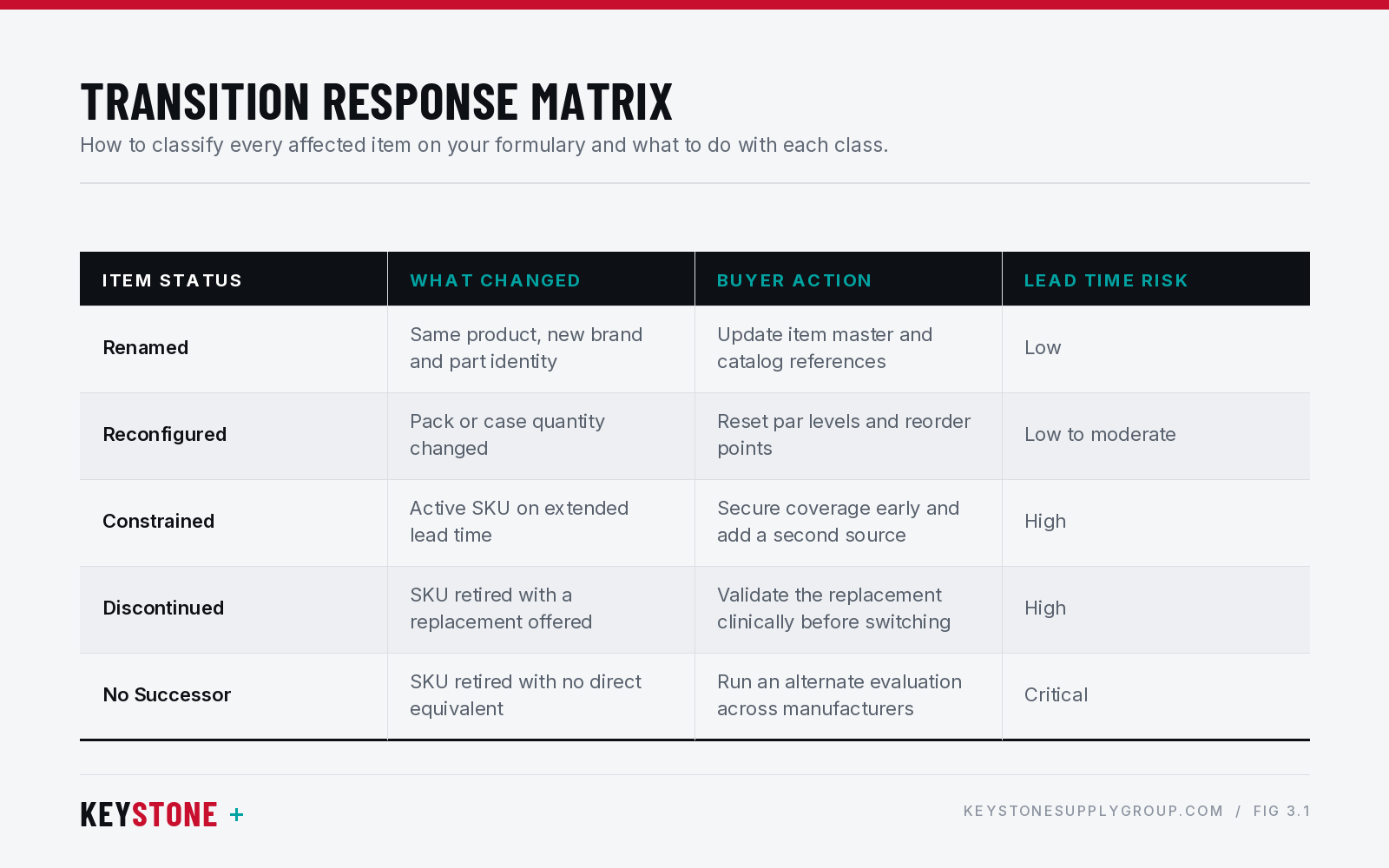
Every item on your formulary that touched the transition falls into one of five buckets. The action is different for each, and treating them all the same is what creates emergencies.
Renamed. Same product, same specification, new brand and often a new catalog reference. The risk here is administrative. If your item master, contract file, punchout catalog, and preference cards still carry only the legacy identity, ordering breaks even though supply is fine.
Reconfigured. The product is the same but pack or case quantity changed. This quietly breaks par levels, reorder points, and budget forecasting. A department that reorders by case count rather than unit count can end up with twice or half the inventory it planned.
Constrained. The SKU is active and available but on an extended lead time. This is the bucket that most often becomes a clinical issue, because nothing looks wrong until the order is placed and the confirmation comes back with a date months out.
Discontinued with a successor. A replacement is offered. The replacement needs clinical validation before it goes into use, not after. Materials, sizing, compatibility with existing equipment, and workflow fit all need a real review.
Discontinued with no direct successor. This is the hardest bucket and the one that requires a genuine alternate evaluation across manufacturers, not a catalog lookup.
The working process
- Export the affected item list. Every SKU in the affected lines that your organization has purchased in the last twelve months, with annual usage and last price.
- Assign a status to each line. Use the five categories above. Leave nothing unassigned.
- Update identity on the low risk items now. Renamed and reconfigured items should be corrected in the item master, catalogs, and par levels immediately. This is free risk reduction.
- Cover the constrained items early. Where lead times are extended, secure position ahead of need and register a second source for the same line.
- Run clinical validation on successors before you are forced to. Validation done under time pressure produces bad substitutions and staff pushback.
- Source the orphans across the market. For retired SKUs with no successor, remaining stock is scattered across distributors rather than sitting in one place.
Where remaining stock lives
Discontinued SKUs do not disappear at once. They drain out of the channel unevenly. Regional distributors, specialty distributors, and sub-distributors often carry usable quantities of a retired part number long after national availability shows zero.
That is a searchable problem, not a hopeless one. Keystone maintains an internal database of 3M and Solventum SKU changes and alternates, tracks which part numbers were renamed versus retired, and sources discontinued items from across the distributor network while they remain available. Where an item genuinely cannot be found, we move the customer to the replacement SKU and set realistic lead time expectations rather than quoting a date we cannot hold.
The audit worth running this quarter
Pull your usage report for the affected lines and ask four questions:
- Which of these items have we ordered in the last twelve months?
- Which ones now show a different part number, pack size, or availability status?
- Which ones would create a clinical problem if they were unavailable for sixty days?
- For that last group, who is our second source, and are they already approved in our system?
If the answer to the fourth question is "nobody yet," that is the fastest thing on the list to fix.
Send us the affected lines
Keystone can cross-reference your affected part numbers against current status, identify which items were renamed, retired, or replaced, source remaining stock where it exists, and quote validated alternates where it does not.
Send your SKU list: Orders@KeystoneSupplyGroup.com | Office (507) 237-6036 | keystonesupplygroup.com