"Out of stock" and "on allocation" look identical on a purchasing screen. They are completely different problems, and confusing them costs buyers weeks.
Out of stock means a specific warehouse has zero units of a specific item today. Allocation means a manufacturer has decided in advance how much product each customer is permitted to buy, regardless of what they order. The first is a timing issue. The second is a rationing system, and it behaves in predictable ways once you know the sequence.
How an allocation actually forms
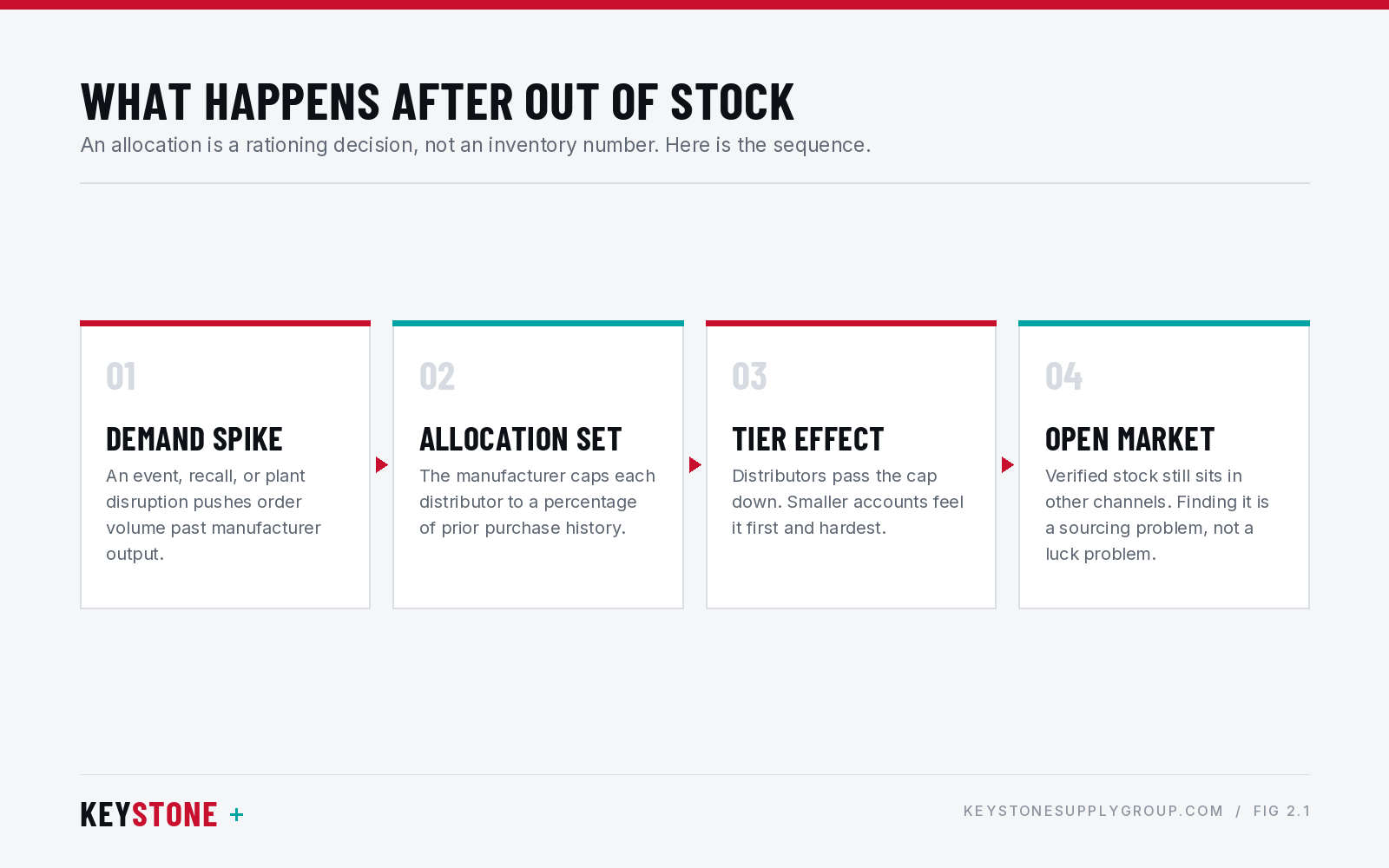
Demand exceeds output. The trigger can be a demand spike, a competitor recall that pushes volume onto the remaining manufacturers, a raw material constraint, a plant outage, or a cyber incident that takes an order system offline. The cause varies. The effect is the same: orders outrun production.
The manufacturer sets caps. Rather than filling on a first come basis, the manufacturer assigns each distributor a percentage of historical purchase volume. This is usually calculated on a trailing period, often the prior twelve months. It is a defensive move that protects the manufacturer from unlimited exposure to panic ordering.
Distributors pass the cap downstream. Each distributor now has less product than its customers want, so it applies the same logic to its own accounts. Large contracted accounts with long purchase histories generally keep the most access. Newer accounts, smaller accounts, and accounts that recently shifted volume see the sharpest cuts, because their trailing history is the smallest.
Ordering behavior makes it worse. Once buyers realize allocation is in effect, many order above true need in order to secure a larger share of the next release. That inflated demand signal reinforces the allocation and extends it. This is the classic whip effect, and it is why an allocation often lasts longer than the underlying disruption that started it.
Where product actually still is
Here is the part that gets missed. An allocation does not mean the product has vanished from the country. It means your normal channel has been capped.
At any point during an allocation, units are usually still sitting in several places:
- Other distributors whose allocation percentage exceeds their current demand
- Regional and specialty distributors outside the major national accounts
- Sub-distributors and secondary market holders carrying prior purchases
- International supply where a product is manufactured or approved in multiple regions
- Adjacent SKUs from the same manufacturer, or equivalent products from a different one
None of that is visible from inside one purchasing portal. One distributor being out tells you exactly one thing about one company's inventory position. It tells you nothing about the market.
What a market view looks like
Keystone maintains a network of more than 490 national, international, and global distributors and suppliers. The practical benefit is not the size of the list. It is the ability to see across it.
When an item goes on allocation, the process is mechanical rather than hopeful:
- Confirm the exact manufacturer part number, unit of measure, and any acceptable equivalents.
- Query distributor and supplier systems and databases for verified on-hand quantity, including Keystone stock.
- Validate that the stock is real, that the dating is acceptable, and that the lot is not affected by any active recall.
- Price it delivered, with lead time stated honestly rather than optimistically.
- Report back what exists, what does not, and what the realistic alternate is.
Step five matters as much as the rest. A supplier who tells you an item genuinely cannot be found this week is more valuable than one who quotes it, takes the order, and delivers nothing in three weeks.
What buyers should do during an allocation
- Order to real usage, not to fear. Inflated orders shrink your future allocation credibility and extend the shortage.
- Get your true burn rate documented. Weekly usage by site is the number that drives every sourcing decision that follows.
- Decide the substitution position early. Know in advance which items accept an equivalent and who signs off. That decision made calmly is much better than one made at hour zero.
- Push the list out wider than one vendor. Multiple channels, same list, same day.
- Keep the second source current. Allocations end and then return. The next one is easier if the account is already open.
When your channel is capped, the market often is not
Send Keystone your backordered, allocated, and shortage lines with priorities, case quantities, and coverage windows. We will check the network, confirm what is verifiably on hand, and come back with delivered pricing and honest lead times.
Send your list: Orders@KeystoneSupplyGroup.com | Office (507) 237-6036 | keystonesupplygroup.com