Most supply failures are not sourcing failures. They are paperwork failures.
The product exists. Someone in the market has it on a shelf. The reason it does not reach your dock in time is that the vendor who has it is not set up in your system, has no signed W-9 on file, has not been added to the approved list, and cannot be paid without a two week finance review. By the time the account is opened, the stock is gone.
The math that makes this obvious
Vendor onboarding at a health system, surgery center, or public agency typically runs two to six weeks. It involves purchasing, accounts payable, compliance, and sometimes legal. None of those steps are unreasonable. They just do not compress.
Allocations move on a different clock. When a manufacturer caps distribution, available stock in secondary channels is usually consumed within days. The window between "we have a problem" and "there is nothing left to buy" is short, and it is not long enough to open a new vendor account inside of it.
That gap is the entire argument for pre-approval. The cost of setting up a secondary vendor while nothing is wrong is a few forms. The cost of setting one up during a shortage is missed cases, expedited freight, and emergency substitutions made under pressure.
What a secondary vendor is not
A secondary vendor is not a replacement for your prime distributor. It is not a plan to renegotiate your contract, split your volume, or run a shadow purchasing program. Those conversations belong somewhere else.
A secondary vendor is a specialist you call for the lines your primary channel cannot fill. Backordered items. Allocated items. Discontinued part numbers with no successor loaded in the catalog. Recalled products that need an immediate equivalent. That is a narrow role, and keeping it narrow is what makes it easy to approve internally.
The framing that works with a purchasing committee is simple: this vendor does not compete for the base business. This vendor exists so that a stockout does not become a clinical problem.
The four step setup
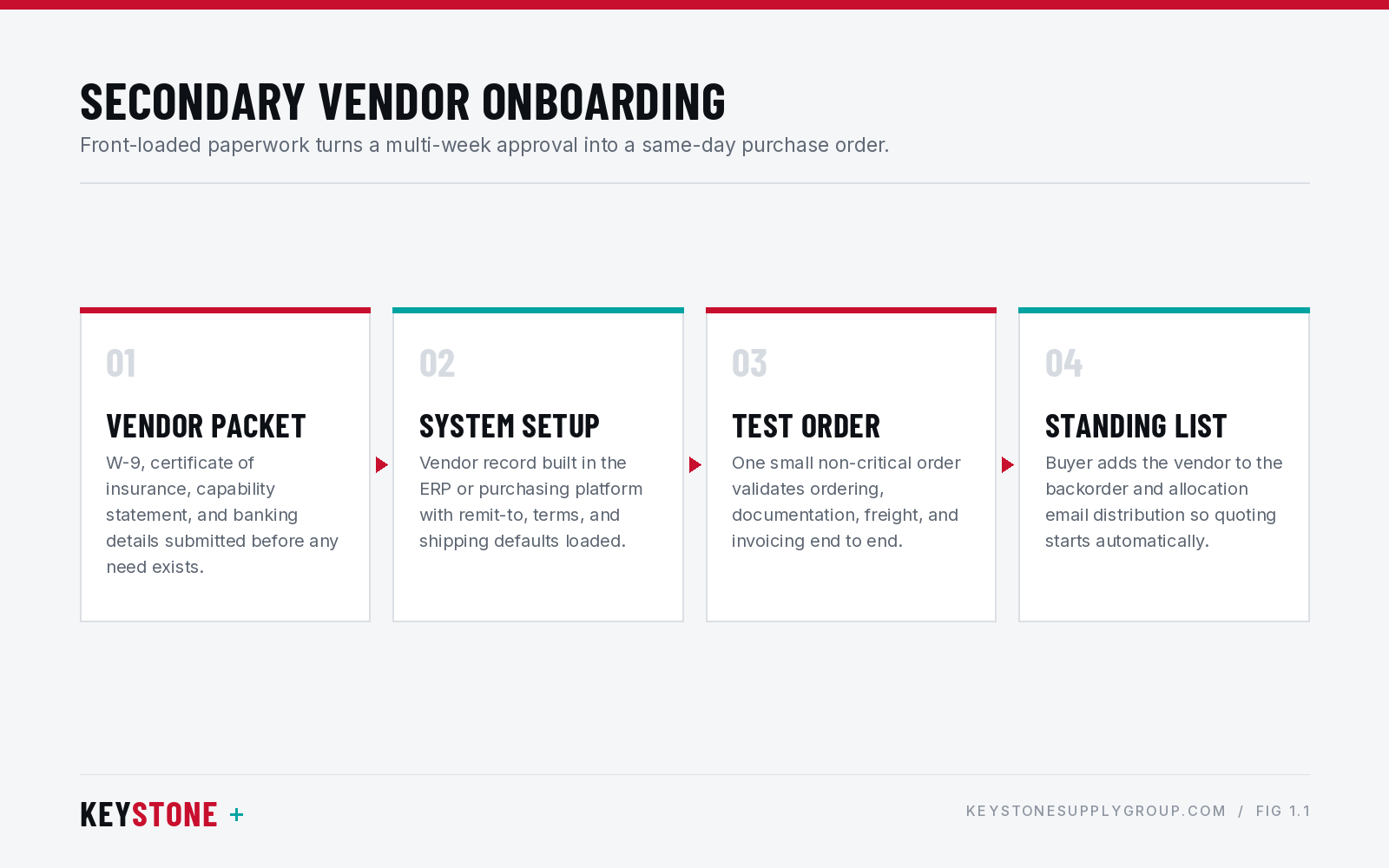
Step one: send the packet. W-9, certificate of insurance, capability statement, banking details, and the NAICS or commodity codes your system needs to categorize the vendor. All of it at once, unprompted.
Step two: build the record. Get the vendor into the ERP or purchasing platform with remit-to information, payment terms, and default ship-from and freight terms already loaded. A vendor record that only half exists will still stop a purchase order at the worst possible moment.
Step three: run one small order. Pick something routine and low risk. Confirm that the purchase order flows, the packing slip matches, the freight terms behave as expected, the invoice matches the PO, and receiving does not flag anything. One test order at a calm moment surfaces every process defect for the price of a single case.
Step four: add them to the list. This is the step most buyers skip. Put the vendor on the distribution list that receives your backorder, shortage, and allocation reports. That single change turns a passive account into an active sourcing partner, because quoting starts the moment your report goes out instead of the moment you remember to ask.
What to measure afterward
Track three things once the secondary source is live:
- Time to quote. How long from list sent to priced response with confirmed availability.
- Fill rate on the hard lines. Not overall fill rate. Fill rate specifically on the items your primary channel could not supply.
- Delivered cost versus emergency alternatives. Compare against what an unplanned expedite actually costs, not against your contract price on an item that is not available at that price.
If those three numbers look right, you have removed a recurring category of risk from your operation for close to nothing.
Get set up now, not later
Keystone Supply Group works as a proactive secondary vendor. We complete vendor forms, insurance documentation, W-9, and banking setup in advance so that when an item goes on allocation, the purchase order can move the same day.
We are not trying to displace your existing distributors or contracts. We exist for the lines they cannot fill.
Start the paperwork: Orders@KeystoneSupplyGroup.com | Office (507) 237-6036 | keystonesupplygroup.com