Substitution has a bad reputation in healthcare purchasing, and it earned it honestly. Too many alternates have been sold on price and availability alone, arrived on the dock, and been rejected by the people who had to use them.
That failure is not an argument against alternates. It is an argument against unstructured alternates. A substitution that has been evaluated properly is a supply chain asset. A substitution that has only been checked for price is a future write-off plus a clinical complaint.
Six checks before anything ships
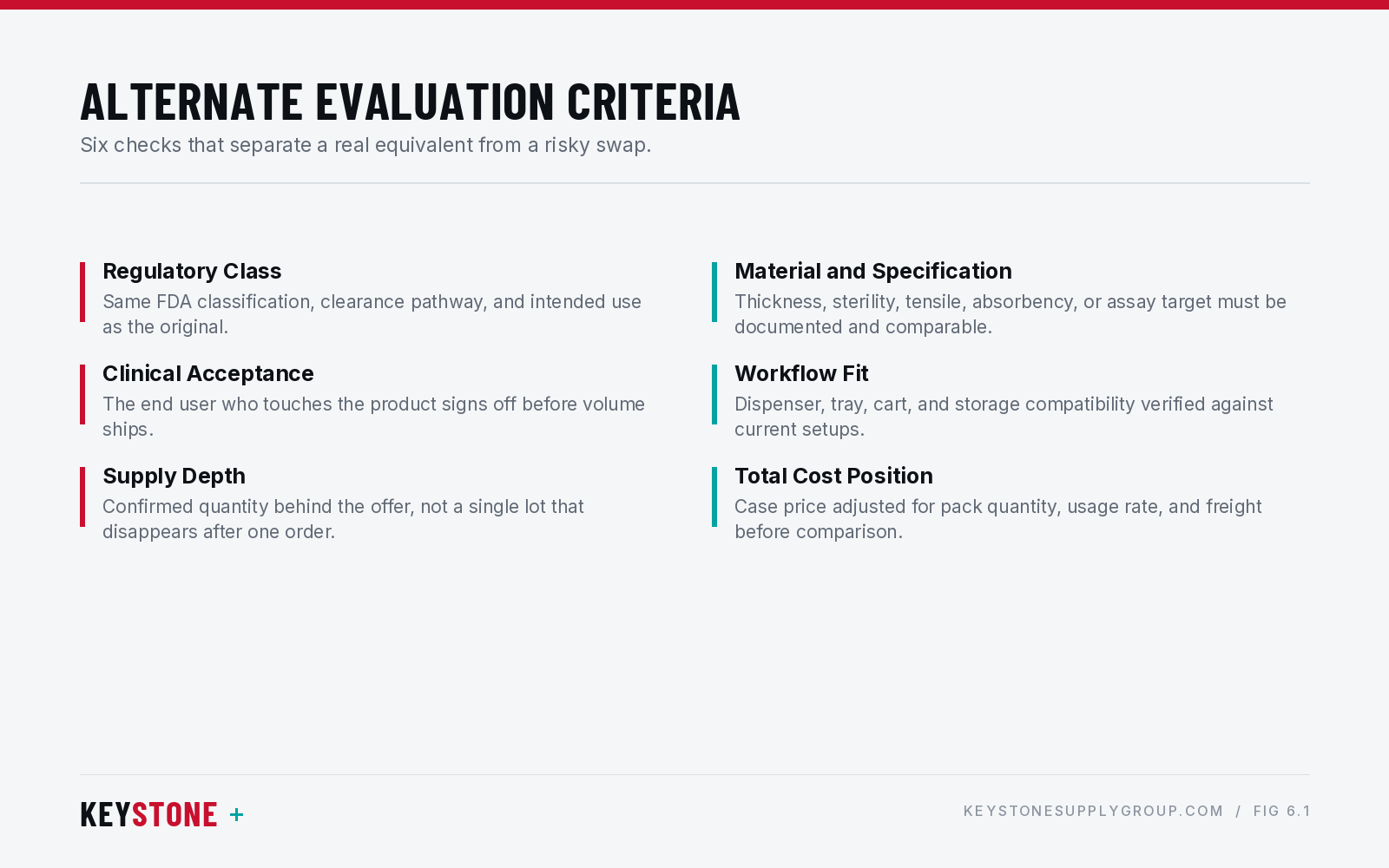
Regulatory class. The alternate should carry the same FDA classification, the same clearance pathway, and the same intended use as the original. This is not a formality. Products that look similar can sit in different regulatory categories, and the distinction matters for both compliance and reimbursement. Diagnostics are the sharpest example, where sample type and intended use setting can change the approval entirely even when the target analyte is identical.
Material and specification. Document the actual numbers rather than the marketing language. For gloves that means material, thickness in mils, length, powder status, texture, and any chemotherapy or fentanyl permeation rating. For gowns it means barrier level and construction. For wound care it means absorbency, adhesive, and border profile. If a spec sheet cannot be produced, treat the alternate as unverified.
Clinical acceptance. The person who touches the product signs off before volume ships. Sample first, with the actual department that will use it, in the actual setting. An alternate approved by purchasing alone and rejected by staff on arrival costs more than the original shortage.
Workflow fit. Confirm the physical realities. Does it fit the dispenser, the cart, the tray, the storage bin, the warmer, the existing accessory? Case quantity and unit packaging changes ripple into par levels and storage capacity. These are unglamorous checks that prevent very avoidable problems.
Supply depth. Ask how much is actually behind the offer. A single lot that satisfies one order and then disappears creates a second transition three weeks later. Two transitions is worse than one shortage. Ask about quantity available, replenishment timing, and lot dating before committing.
Total cost position. Compare on delivered cost per unit of use, not case price. Pack quantity differences, usage rate differences, and freight all change the real number. A cheaper case that contains fewer units, or that staff use more of per procedure, is not cheaper.
The documentation to keep
For every approved alternate, keep a short record with:
- Original item and manufacturer part number
- Alternate item and manufacturer part number
- Side by side specification comparison
- Regulatory classification of both
- Who approved it clinically, and on what date
- Any conditions on use, such as approved for specific departments only
That record is worth building because shortages repeat. The second time the same item goes unavailable, an approved alternate on file turns a multi week evaluation into a same day purchase order. It also matters in audits, where "we substituted during a shortage" is a much stronger position with documentation attached.
Where alternates come from
Good alternates come from three places, in roughly this order of preference:
- Same manufacturer, different SKU. A different size, pack configuration, or adjacent product line. Lowest evaluation burden because the manufacturer quality system is already known.
- Different manufacturer, equivalent product. Requires the full six point evaluation, but is the most common path during a true allocation.
- Different format entirely. Changing from one product form to another that accomplishes the same clinical purpose. Highest evaluation burden, occasionally the only option.
The wrong answer is a fourth path: an unverified offer from an unknown source with no specification sheet, no traceability, and no answer about lot dating. Availability is not the only thing worth checking during a shortage.
We do the evaluation work, not just the lookup
Keystone sources alternates across a network of more than 490 distributors and suppliers, and provides specification documentation, regulatory classification, and lot and dating detail so your clinical team can approve or reject a substitution on facts rather than a price sheet.
Send the item you cannot get: Orders@KeystoneSupplyGroup.com | Office (507) 237-6036 | keystonesupplygroup.com