Some supply disruptions are genuinely unpredictable. A recall, a cyber incident at a manufacturer, a plant fire. Those require a standing capability rather than a plan.
Most disruptions are not like that. They arrive at approximately the same time every year, for the same reasons, with the same effects. Treating a scheduled event as an emergency is a choice, and it is an expensive one.
The recurring windows
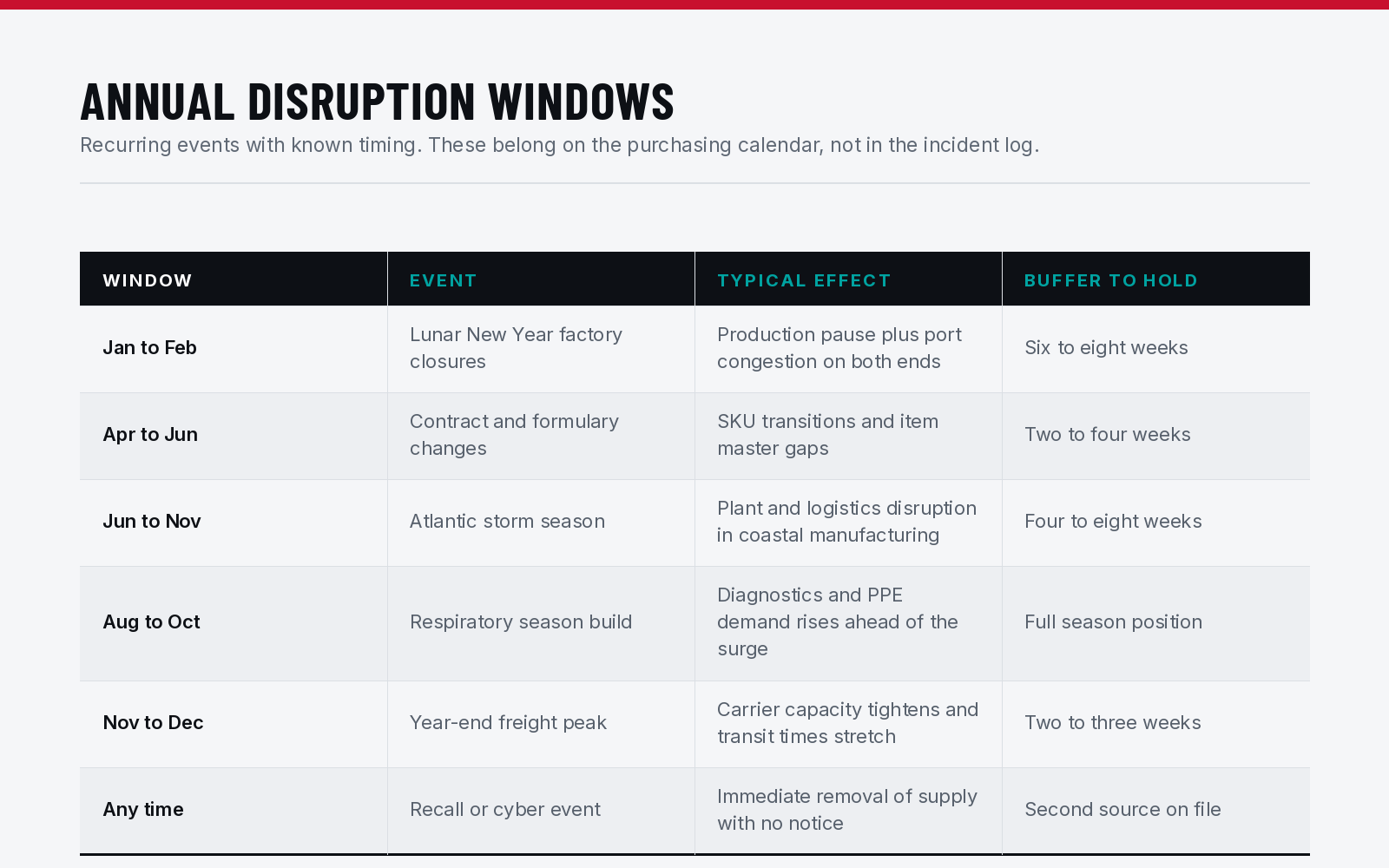
Lunar New Year, roughly January into February. Manufacturing across much of Asia pauses for a period that in practice runs longer than the holiday itself. Production slows before the shutdown as workers travel and ramps slowly afterward. Port congestion builds on both ends. For any product with an overseas manufacturing base, including a large share of gloves, PPE, and diagnostics, this is the single most predictable annual supply gap. Coverage of six to eight weeks is a reasonable planning target.
Contract and formulary transitions, often second quarter. New contracts, new item numbers, and portfolio changes create gaps between the item your system knows and the item your supplier can ship. These are administrative disruptions and they are entirely preventable with an item master review before the effective date.
Atlantic storm season, June through November. Coastal and Gulf manufacturing and distribution infrastructure is exposed for half the year. The IV fluid disruption after a single facility was damaged is the clearest recent example of what geographic concentration means in practice. If a critical item is produced in one plant in an exposed region, that is a risk worth naming out loud during planning.
Respiratory season build, August through October. Diagnostics and PPE demand rises before the surge, not during it. Waiting until demand is visible in your own facilities means competing with everyone who planned earlier.
Year end freight peak, November into December. Carrier capacity tightens, transit times stretch, and accessorial costs rise. Orders that would normally arrive in three days take a week. Building two to three weeks of additional lead time into December ordering avoids most of the pain.
Foreign holidays throughout the year. Beyond Lunar New Year, suppliers in various regions close for national holidays that can run up to a week. These are easy to plan around once documented, and disruptive when discovered mid order.
Turning the calendar into practice
Build the item level exposure map. For your critical items, note where the product is manufactured, which of the windows above it is exposed to, and what your normal lead time is. Most organizations have never written this down, and writing it down takes an afternoon.
Set buffer targets by window, not globally. A blanket "hold four weeks of everything" is expensive and imprecise. Product exposed to overseas manufacturing needs a deeper buffer heading into the first quarter than a domestically produced item does.
Put purchase actions on the calendar with lead time backed in. If Lunar New Year coverage requires eight weeks and your lead time is four, the order date is twelve weeks ahead of the window. That date belongs on a calendar, not in someone's memory.
Review after each window. Did the buffer hold, was it too large, what actually stretched. Two or three cycles of that review produces a genuinely accurate model of your own exposure.
Keep one capability for the unscheduled events. Recalls and cyber incidents give no warning. The only real defense is an approved secondary source that can be activated the same day. That is not a plan you can build during the event.
Plan the known, cover the unknown
Keystone helps customers position ahead of predictable disruption windows and provides sourcing capacity for the unpredictable ones, working from a network of more than 490 national, international, and global distributors and suppliers.
Get the vendor approval done during a calm quarter so the capability is there when it is not.
Start planning: Orders@KeystoneSupplyGroup.com | Office (507) 237-6036 | keystonesupplygroup.com